Hesse & Knipps
LW2095
Provisional entry — research in progress
This page was generated automatically from cited public sources and hasn't completed the full research pass yet. Every specification shown carries its source; more detail is added as research completes.
The LW2095 is a laser welder. The LW2095 is a fully automatic laser welding system with two weldheads and an extra large working area. The LW2095 is used for deep penetration welding of aluminum and copper leads on DCB substrates, power electronics, battery cells and modules, and other electronics manufacturing components.[1]
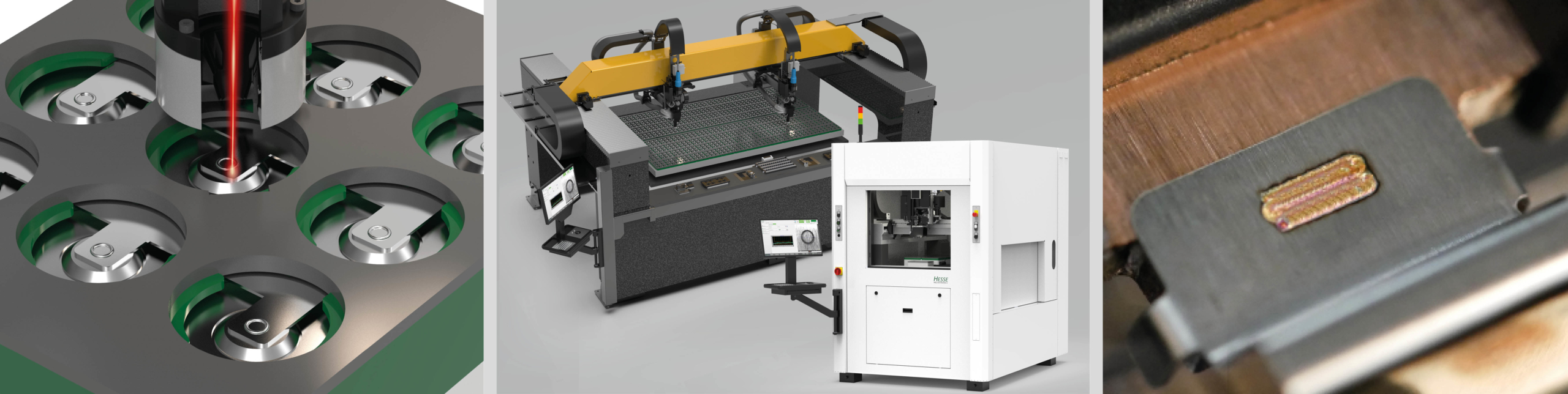
How it works
The LW2095 performs joining by directing a laser beam along a weld seam to create intermetallic joints. The LW2095 supports temporal and spatial laser power modulation for different weld geometries and weld depths. The LW2095 uses a movable holding-down device to limit contamination of surrounding areas by weld pool ejections during welding. The LW2095 uses high axis accuracy and process control to support reproducible clamping force and welding conditions. The LW2095 uses a standardized clamp and weld concept for adjustment to different product variants and for automatic reaction to component tolerances of the joining partners.[1]
What do the numbers mean?
Power & electrical3
Optics & imaging9
- Machine type
- Fully automatic laser welding system with two weldheads and an extra large working area[1]
- Process monitoring
- Sensors for process illumination (plasma, thermal illumination and backscattered radiation)[1]
- Service stations
- Tool force calibration module; E-Box station for laser beam alignment; tool changing station; integrated beam shape measurement and focus position determination; off-bond station for welding samples[1]
Control & software1
Dimensions & facilities2
Configuration & options6
What does it need to run?
Site utility requirements, footprint, and infrastructure needed to install and operate this tool. Sourced from public records.
Where are the manuals?
Generated from public-source data on file. Enter your email to access — nothing is published; details are routed privately.
Not publicly documented
Field notes
No research found yet — worked with this tool? Share what you know.
Frequently asked questions
What joining tasks is the LW2095 intended to perform?
The LW2095 is intended for fully and semi-automatic deep penetration welding of aluminum and copper leads on DCB substrates, in power electronics, battery cells and modules, or other electronics manufacturing components.[1]
Not publicly documented
The following facts about the LW2095 are absent from this record as of this revision. First-hand knowledge or a citation closes a gap; every submission is reviewed before publication.
No publicly documented production dates or lifecycle milestones (introduction, end of production, EOL) for the LW2095 are on record.
Answerable by: OEM historical records or a trade-press announcement
No publicly documented variants, configuration options, or revision breakpoints of the LW2095 are on record.
Answerable by: an OEM product catalog or an engineer who ordered or specified the tool
The control-system platform and OS era of the LW2095 are not on record.
Answerable by: an engineer who operated it or OEM installation records
No publicly documented failure modes or field errata for the LW2095 are on record.
Answerable by: a field service engineer, process engineer, or maintenance technician
The process node or technology generation of the LW2095 is not on record.
Answerable by: an OEM datasheet or a fab qualification report
No research found yet — worked with this tool? Share what you know.
Sources & citations
Sources (4)Every fact above is drawn from these public sources
- [1]hesse-mechatronics.com — hesse-mechatronics.comhesse-mechatronics.com
- [2]hesse-mechatronics.com — hesse-mechatronics.comhesse-mechatronics.com
- [3]diagon.ai — diagon.aidiagon.ai
- [4]LW2095 — Hesse & Knipps | Specs, Sourcing & Service | Waferpedia — waferpedia.comwaferpedia.com
Last updated Oct 16, 2026.
Compare with similar tools
View all →
Applied Materials model 0010-47763 is an ASSY ESC Bonded Monopolar Dual Heated unit.
The Applied Materials 0041-26723 is a bonded assembly used in semiconductor packaging and bonding applications.
The Logitech 1 WBS 1 is a wafer substrate bonder for 6-inch wafers.

