West Bond
wirebond2
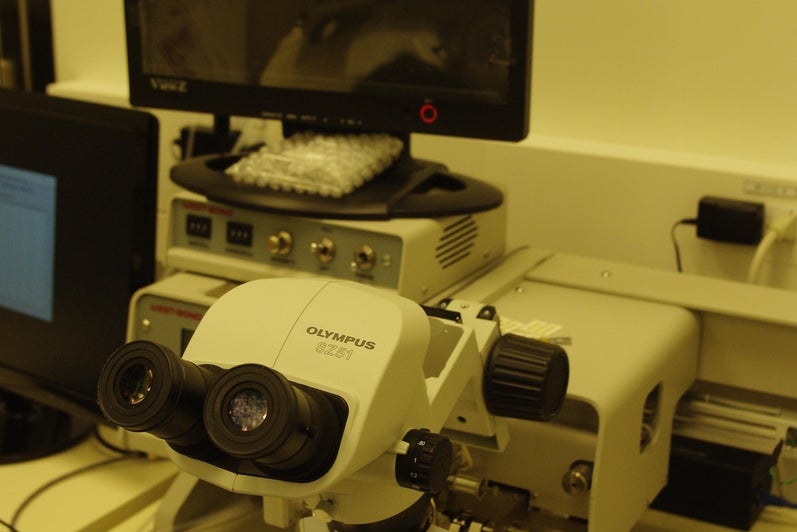
What it is
General reference — not yet source-verifiedA wire bonder is packaging equipment that forms electrical interconnects between a die and its package or substrate using fine wire. Wedge bonders are commonly used after die attach, when bond pads on the device and package are ready to be interconnected. Semi-automatic wire bonders combine operator positioning and setup with machine-controlled bonding motions.
How it works
The West Bond wirebond2 uses ultrasonic energy to bond wire leads between wafer dies and contact pads of electronic packages. The West Bond wirebond2 has microprocessor controllable motion in the Z and Y axes. The West Bond wirebond2 is typically left configured for 1 mil 25 μm aluminum wire in wedge bonding configuration. The West Bond wirebond2 has programmable bonding steps for repeatable wire profile control. The West Bond wirebond2 includes a look down camera and screen for bond placement.[1]
The West Bond wirebond2 is convertible between 45 degree wedge bonding and 90 degree deep access wedge bonding. The West Bond wirebond2 is compatible with aluminum and gold wires from 0.7 mil to 2 mil in diameter for room temperature thermosonic bonding. The West Bond wirebond2 has multiple heated workholders available. The West Bond wirebond2 has a 5 W, 63 kHz transducer.[1]
Where it fits in the process flow
General reference — not yet source-verifiedWire bonding is a back-end packaging step that follows die singulation or die preparation and die attach. Wire bonding connects the active device to the package or carrier so the assembly can proceed to encapsulation, lid attach, test, or further package integration. In research and prototyping flows, wire bonding is commonly used when bare dies must be electrically accessed on carriers, packages, or custom assemblies.
Applications
The West Bond wirebond2 is used for making electrical contacts between semiconductor dies and packages. The West Bond wirebond2 is used to bond wire leads between wafer dies and contact pads of electronic packages. The West Bond wirebond2 is typically configured for aluminum wire and is compatible with aluminum and gold wire. The West Bond wirebond2 also has ribbon capability up to 1x10 mil gold ribbon.[1][2]
- Making electrical contacts between semiconductor dies and packages
What do the numbers mean?
Power & electrical3
Wafer handling1
- Bonding method
- uses ultrasonic energy to bond wire leads between wafer dies and contact pads of electronic packages[1]
Optics & imaging3
Control & software2
Configuration & options23
- Compatible wire materials and sizes
- Al and Au wires from 0.7 mil to 2 mil in diameter for room temperature thermosonic bonding[1]2 sources
What does it need to run?
Site utility requirements, footprint, and infrastructure needed to install and operate this tool. Sourced from public records.
Where are the manuals?
Generated from public-source data on file. Enter your email to access — nothing is published; details are routed privately.
Not publicly documented
Field notes
No research found yet — worked with this tool? Share what you know.
Frequently asked questions
What type of bonding tool is the West Bond wirebond2?
The West Bond wirebond2 is a semi-automatic wedge bond tool.[1][2]
What is the West Bond wirebond2 used for?
The West Bond wirebond2 is used for making electrical contacts between semiconductor dies and packages.[1][3][2]
What wire configuration is typical on the West Bond wirebond2?
The West Bond wirebond2 is typically left configured for 1 mil 25 μm aluminum wire in wedge bonding configuration.[1][2]
What bonding modes and wire types does the West Bond wirebond2 support?
The West Bond wirebond2 is convertible between 45 degree wedge bonding and 90 degree deep access wedge bonding. The West Bond wirebond2 is compatible with aluminum and gold wires from 0.7 mil to 2 mil in diameter for room temperature thermosonic bonding.[1]
Not publicly documented
The following facts about the wirebond2 are absent from this record as of this revision. First-hand knowledge or a citation closes a gap; every submission is reviewed before publication.
No publicly documented production dates or lifecycle milestones (introduction, end of production, EOL) for the wirebond2 are on record.
Answerable by: OEM historical records or a trade-press announcement
No publicly documented variants, configuration options, or revision breakpoints of the wirebond2 are on record.
Answerable by: an OEM product catalog or an engineer who ordered or specified the tool
The control-system platform and OS era of the wirebond2 are not on record.
Answerable by: an engineer who operated it or OEM installation records
No publicly documented failure modes or field errata for the wirebond2 are on record.
Answerable by: a field service engineer, process engineer, or maintenance technician
The process node or technology generation of the wirebond2 is not on record.
Answerable by: an OEM datasheet or a fab qualification report
No research found yet — worked with this tool? Share what you know.
Sources & citations
Sources (5)Every fact above is drawn from these public sources
- [1]uwaterloo.ca — uwaterloo.cauwaterloo.ca
- [2]qnfcf.uwaterloo.ca — qnfcf.uwaterloo.caqnfcf.uwaterloo.ca
- [3]Wirebonder: Semi-automatic Wedge [WESTBOND-wirebond2] — Plone site — qnfcf.uwaterloo.caqnfcf.uwaterloo.ca
- [4]Packaging Lab | Quantum-Nano Fabrication and Characterization Facility | University of Waterloo — uwaterloo.cauwaterloo.ca
- [5]wirebond2 — West Bond | Specs, Sourcing & Service | Waferpedia — waferpedia.comwaferpedia.com
Last updated Oct 17, 2026.
Compare with similar tools
View all →
Applied Materials model 0010-47763 is an ASSY ESC Bonded Monopolar Dual Heated unit.
The Applied Materials 0041-26723 is a bonded assembly used in semiconductor packaging and bonding applications.
The Logitech 1 WBS 1 is a wafer substrate bonder for 6-inch wafers.

