OAI
200
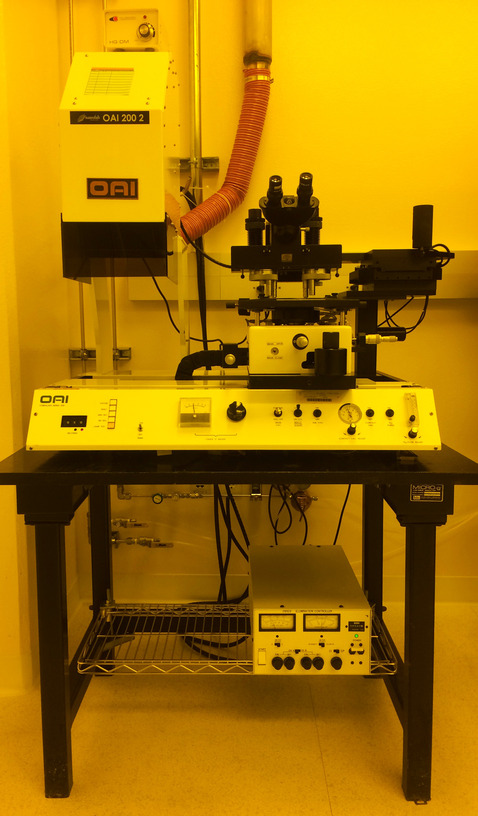
What it is
The OAI 200 is a tabletop mask aligner and UV exposure system.[3][5]
The OAI 200 is used for photolithography tasks that require aligning a photomask to a substrate and then exposing the substrate to ultraviolet light.[3][5]
How it works
The OAI 200 uses an alignment module, an exposure system, light sources, a regulated power-adjustable power supply, a constant intensity controller, shutter and field-illumination control, and alignment optics.[3]
The OAI 200 uses a vacuum chuck for substrate placement and alignment during exposure.[3]
The OAI 200 uses UV exposure systems with power ranging from 200 to 2000 watts and radiation from 220 nm to 436 nm.[3]
Where it fits in the process flow
The OAI 200 can handle pieces of substrates up to six inch diameter wafers or six inch by six inch square substrates.[3]
Applications
The OAI 200 is used for MEMS, nanotechnology, semiconductor bench-top work, microfluidics, thin-film devices, solar cells, display processing, and related UV exposure applications.[4][5]
The OAI 200 can be configured for nanoimprint lithography and for microfluidics applications.[4]
- Lithography
- Alignment
What do the numbers mean?
Vacuum & pumping3
Wafer handling2
Optics & imaging4
Performance1
Dimensions & facilities3
Configuration & options9
What replaced it?
Alternatives
Tools documented as functional equivalents — same process step and wafer size, from a different manufacturer. Each equivalence cites its source.
- SUSS MicroTec MA 6 Mask— Same function class: Lithography, nullCompare in depthsource[6]
- SUSS MicroTec MA 200 Gen 3 Mask— Same function class: Lithography, nullCompare in depthsource[7]
What does it need to run?
Site utility requirements, footprint, and infrastructure needed to install and operate this tool. Sourced from public records.
Where are the manuals?
Generated from public-source data on file. Enter your email to access — nothing is published; details are routed privately.
Not publicly documented
Field notes
No research found yet — worked with this tool? Share what you know.
Frequently asked questions
Not publicly documented
The following facts about the 200 are absent from this record as of this revision. First-hand knowledge or a citation closes a gap; every submission is reviewed before publication.
No publicly documented production dates or lifecycle milestones (introduction, end of production, EOL) for the 200 are on record.
Answerable by: OEM historical records or a trade-press announcement
No publicly documented variants, configuration options, or revision breakpoints of the 200 are on record.
Answerable by: an OEM product catalog or an engineer who ordered or specified the tool
The control-system platform and OS era of the 200 are not on record.
Answerable by: an engineer who operated it or OEM installation records
No publicly documented failure modes or field errata for the 200 are on record.
Answerable by: a field service engineer, process engineer, or maintenance technician
The process node or technology generation of the 200 is not on record.
Answerable by: an OEM datasheet or a fab qualification report
No research found yet — worked with this tool? Share what you know.
Sources & citations
Sources (8)Every fact above is drawn from these public sources
- [1]nanofab.utah.edu — nanofab.utah.edunanofab.utah.edu
- [2]nanofab.utah.edu — nanofab.utah.edunanofab.utah.edu
- [3]manualslib.com — manualslib.commanualslib.com
- [4]oainet.com — oainet.comoainet.com
- [5]oainet.com — oainet.comoainet.com
- [6]snfguide.stanford.edusnfguide.stanford.edu
- [7]web.archive.orgweb.archive.org
- [8]Request Equipment Training or Service | Utah Nanofab — nanofab.utah.edunanofab.utah.edu
Last updated Aug 14, 2026.
Compare with similar tools
View all →
The SUSS MA 200 Gen 3 is a mask aligner for lithography applications, with source-stated wafer sizes of 6 inch and 8 inch and an OEM-stated maximum wafer size of up to 8"/200 mm.

The SUSS MA 6 Mask Aligner is a semiconductor lithography tool used for mask alignment and exposure, supporting various wafer sizes and featuring infrared alignment and a split-field microscope.
Brooks 017-0146-01 is a prealigner manufactured by Brooks.