Oxford Instruments
PRS900
The Oxford Instruments PRS900 is a barrel reactor plasma stripper dedicated to dry resist stripping. The PRS900 uses oxygen plasma (RF capacitive or microwave) for purely chemical and isotropic etching. The PRS900 accepts up to 25 wafers of 4 or 6 inches on a quartz carrier.[1]
Wafer size
6"
Power
RF capacitive or micro-wave oxygen plasma[1]
Performance
0.035 um/min[1]
Gas delivery
dedicated to dry resist stripping[1]
What it is
How it works
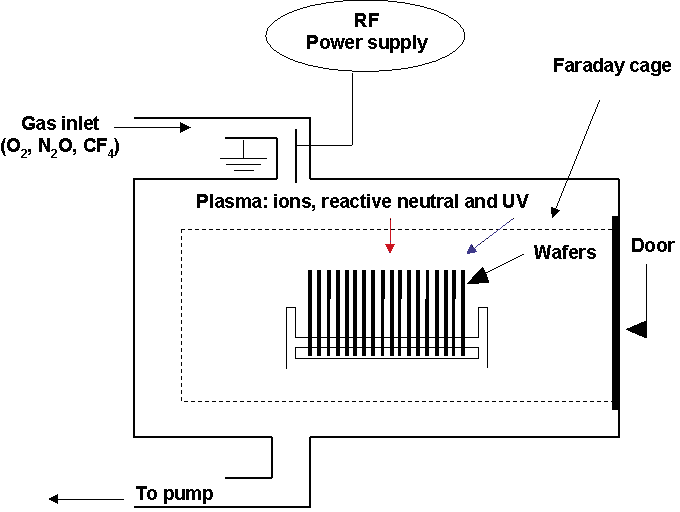
The Oxford Instruments PRS900 uses oxygen plasma generated by RF capacitive or microwave excitation. The Oxford Instruments PRS900 performs etching that is purely chemical and isotropic. The Oxford Instruments PRS900 drives reactive gas to a barrel that acts as a Faraday cage, so RF waves do not enter the treatment chamber. The Oxford Instruments PRS900 does not filter plasma ultraviolet radiation, and that radiation thermally activates oxidation.[1][2]
The Oxford Instruments PRS900 uses a quartz sample carrier sized for wafers of 4 inches or 6 inches. The Oxford Instruments PRS900 carrier accepts up to 25 wafers in a batch. The Oxford Instruments PRS900 limits manual handling to loading and unloading the quartz carrier.[1][2]
Where it fits in the process flow
The Oxford Instruments PRS900 is used in the photolithography process flow to strip photoresist residues after patterning. The Oxford Instruments PRS900 includes standard PR recipes named PR Ox5, PR Ox30, and PR Ox60. The Oxford Instruments PRS900 reports a mean photoresist etch rate of 0.035 µm/min for those recipes, with recipe descriptions for residual removal after photolithography, about 1 µm of photoresist removal, and about 2 µm of photoresist removal.[1][2]
Applications
The Oxford Instruments PRS900 is dedicated to dry resist stripping. The Oxford Instruments PRS900 is used for stripping photoresist residuals after photolithography. The Oxford Instruments PRS900 requires microelectronic compatibility, and Cu, Ag, Au, and Cr are forbidden materials.[1][2]
- dry resist stripping
- stripping of PR residuals after photolithography
- stripping of about 1 µm of PR
- stripping of about 2 µm of PR
Why won't it start?
Documented failure modes, common issues, and field considerations.
- Microelectronic compatibility is required; Cu, Ag, Au, and Cr are forbidden materials
What do the numbers mean?
Power & electrical5
- Chamber configuration
- Barrel acts as Faraday cage, RF waves do not enter chamber; plasma UV radiations not filtered[1]
- Plasma source
- Oxygen plasma (RF capacitive or micro-wave), giving rise to oxygen atoms creation[1]
- Reactor shielding
- The barrel acts as a Faraday cage so RF waves do not enter the treatment chamber[1]
Wafer handling14
- Control
- Completely computer driven; the only manual handling is the loading/unloading step of the quartz samples carrier[1]
Gas & chemistry7
Performance6
- Recipe PR Ox5 (5 min)
- Mean etch rate 0.035 µm/min; stripping of PR residuals after photolithography[1]
Control & software5
Configuration & options11
What does it need to run?
Site utility requirements, footprint, and infrastructure needed to install and operate this tool. Sourced from public records.
- Processdedicated to dry resist stripping[1]
- Etching characterpurely chemical and isotropic[1]
- Plasma sourceoxygen plasma (RF capacitive or micro-wave)[1]
- ProcessDry resist stripping, purely chemical and isotropic etching[1]
- Chamber configurationBarrel acts as Faraday cage, RF waves do not enter chamber; plasma UV radiations not filtered[1]
- Mean resist etch rate0.035 µm/min for PR (for 5, 30, or 60 min recipes)[1]
- Plasma sourceRF capacitive or micro-wave oxygen plasma[1]
- Etch typePurely chemical, isotropic[1]
- Process typeDry resist stripping; etching processes are purely chemical and isotropic[1]
- Plasma sourceOxygen plasma (RF capacitive or micro-wave), giving rise to oxygen atoms creation[1]
- Reactor shieldingThe barrel acts as a Faraday cage so RF waves do not enter the treatment chamber[1]
- Primary usedry resist stripping[1]
Where are the manuals?
Generated from public-source data on file. Enter your email to access — nothing is published; details are routed privately.
Not publicly documented
Field notes
No research found yet — worked with this tool? Share what you know.
Frequently asked questions
What is the Oxford Instruments PRS900 used for?
The Oxford Instruments PRS900 is dedicated to dry resist stripping and is used to strip photoresist residuals after photolithography.[1][2]
What plasma chemistry and excitation does the Oxford Instruments PRS900 use?
The Oxford Instruments PRS900 uses oxygen plasma with RF capacitive or microwave excitation.[1][2]
Not publicly documented
The following facts about the PRS900 are absent from this record as of this revision. First-hand knowledge or a citation closes a gap; every submission is reviewed before publication.
No publicly documented production dates or lifecycle milestones (introduction, end of production, EOL) for the PRS900 are on record.
Answerable by: OEM historical records or a trade-press announcement
No publicly documented variants, configuration options, or revision breakpoints of the PRS900 are on record.
Answerable by: an OEM product catalog or an engineer who ordered or specified the tool
The control-system platform and OS era of the PRS900 are not on record.
Answerable by: an engineer who operated it or OEM installation records
The process node or technology generation of the PRS900 is not on record.
Answerable by: an OEM datasheet or a fab qualification report
No publicly documented compatible parts, consumables, or accessories for the PRS900 are on record.
Answerable by: an OEM parts catalog or a service engineer
Sources & citations
Sources (3)Every fact above is drawn from these public sources
- [1]epfl.ch — epfl.chepfl.ch
- [2]waferpedia.com — waferpedia.comwaferpedia.com
- [3]Oxford Instruments PRS900 family | Waferpedia — waferpedia.comwaferpedia.com
Last updated Oct 20, 2026.
Compare with similar tools
View all →The Dektak 6M is a stylus profilometer used for film step-height measurement, surface topography profiling, and surface roughness measurement.
The Glen/YES 1000FP is a plasma cleaning system designed to accept a range of shelf sizes for changing flat panel industry needs.
The 1000P is a plasma cleaning system with four 16 x 16 inch shelves and a total capacity of 1024 square inches.
