Hamatech
HMR900
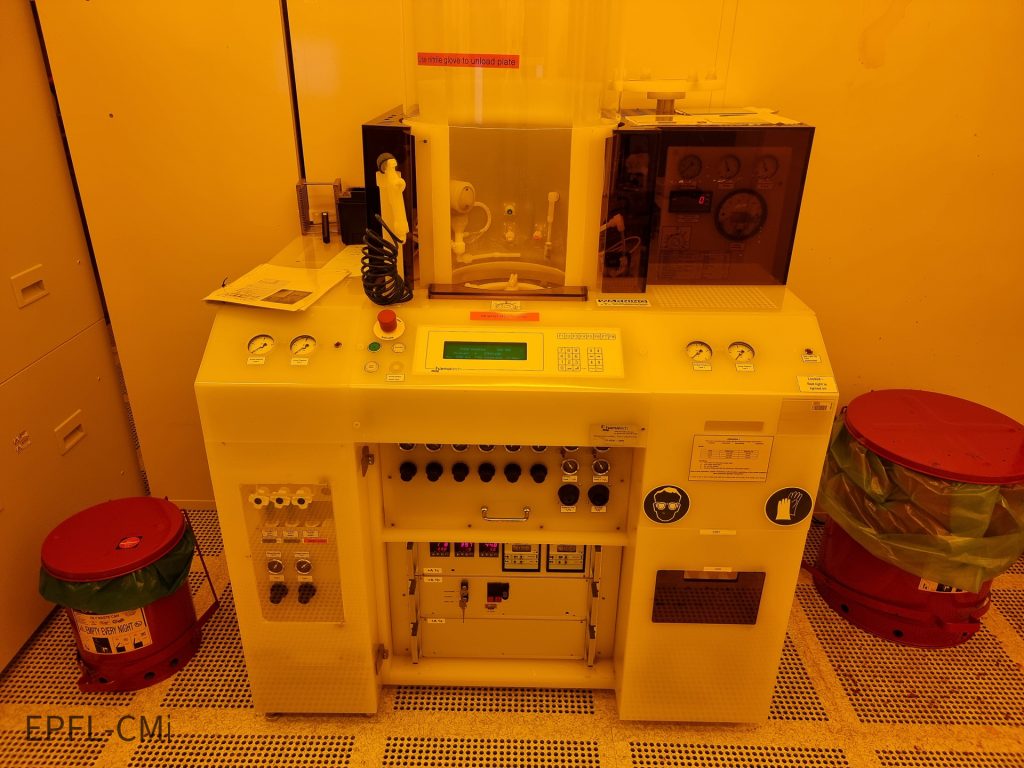
The Hamatech HMR900 is a mask processor dedicated to Cr-plate wet processing and cleaning. The Hamatech HMR900 handles square plates up to 7 x 7 inches, including 4, 5, and 7 inch masks for mask-aligner usage and 6 inch reticules for DUV stepper usage. The Hamatech HMR900 performs developing, chromium wet etching, and resist stripping using three dedicated chemical media.[1]
Wafer size
4"
Performance
+/-1 rpm[1]
Gas delivery
Cr wet etching with TechniEtch Cr N°1[1]
Optics
Mask processor[1]
What it is
The Hamatech HMR900 is a mask processor for Cr-plate wet processing or cleaning. The Hamatech HMR900 is dedicated to successive chemical treatment of standard chromium blanks. The Hamatech HMR900 handles square plates up to 7 inch by 7 inch, including 4 inch, 5 inch, and 7 inch masks for mask-aligner use and 6 inch reticules for DUV stepper use.[1][2][4]
How it works
The Hamatech HMR900 uses manual loading and unloading of substrates. The Hamatech HMR900 uses a multi-size chuck for square plates in 4 inch by 4 inch, 5 inch by 5 inch, and 6 inch by 6 inch formats, and it also uses a chuck for 7 inch by 7 inch square plates. The Hamatech HMR900 holds substrates with mechanical side-edge fixation. The Hamatech HMR900 does not use vacuum clamping for Cr plates and instead uses mechanical corner-stops during processing. The Hamatech HMR900 supports direct and reverse rotation in clockwise and counterclockwise directions. The Hamatech HMR900 has smooth acceleration and speed accuracy of plus or minus 1 rpm. The Hamatech HMR900 can be programmed with 20 recipes of 50 steps each.[1][2]
The Hamatech HMR900 has three dedicated media for successive chemical treatment. The Hamatech HMR900 performs exposed resist development with AZ 351B developer, chromium wet etching with TechniEtch Cr N°1, and resist stripping with AZ 400K used without dilution. The Hamatech HMR900 includes intermediate deionized water rinse steps and final drying.[1][2]
Where it fits in the process flow
Applications
The Hamatech HMR900 is used for developing exposed resist, chromium wet etching, and resist stripping on Cr plates. The Hamatech HMR900 is intended for standard chromium blanks used as masks for mask aligners and as reticles for DUV steppers.[1][2]
- Developing exposed resist
- Cr wet etching
- Resist stripping
Why won't it start?
Documented failure modes, common issues, and field considerations.
- Chucks for Cr plates do not use vacuum clamping; only mechanical corner-stops hold the plates during processing.
- Take care for correct substrate loading.
What do the numbers mean?
Vacuum & pumping3
- Substrate fixation
- Mechanical side edge substrate fixation; chucks for Cr plates do not use vacuum clamping[1]
Wafer handling12
- Substrate size
- Square plates up to 7 x 7 inches; chucks for 4 x 4, 5 x 5, 6 x 6, and 7 x 7 inch square plates[1]
Gas & chemistry7
- Installed media
- Developing exposed resist (AZ 351B developer), Cr wet etching (TechniEtch Cr N°1), and resist stripping (AZ 400K non-diluted)[1]
- Chemical media
- AZ 351B developer, TechniEtch Cr N°1, AZ 400K non-diluted, with DI water rinse and drying[1]
- Process steps
- developing exposed resist, Cr wet etching, resist stripping, intermediate DI water rinse steps, and final drying[1]2 sources
Optics & imaging3
- Supported mask and reticle types
- 4, 5 and 7 inch masks for mask-aligner usage; 6 inch reticules for DUV stepper usage[1]
Performance3
Control & software4
Configuration & options6
What replaced it?
Related models
- siblingEV Group EVG 150source[3]
What does it need to run?
Site utility requirements, footprint, and infrastructure needed to install and operate this tool. Sourced from public records.
- Installed mediaDeveloping exposed resist (AZ 351B developer), Cr wet etching (TechniEtch Cr N°1), and resist stripping (AZ 400K non-diluted)[1]
- Substrate fixationMechanical side edge substrate fixation; chucks for Cr plates do not use vacuum clamping[1]
- Substrate fixationMechanical side edge (corner-stops), no vacuum clamping[1]
- Chemical mediaAZ 351B developer, TechniEtch Cr N°1, AZ 400K non-diluted, with DI water rinse and drying[1]
- Chemical treatment 1Developing exposed resist with AZ 351B developer[1]
- Chemical treatment 2Cr wet etching with TechniEtch Cr N°1[1]
- Chemical treatment 3Resist stripping with AZ 400K non-diluted[1]
- Process stepsdeveloping exposed resist, Cr wet etching, resist stripping, intermediate DI water rinse steps, and final drying[1]
- Substrate fixationMechanical side-edge fixation; no vacuum clamping for Cr plates[2]
- Process mediaAZ 351B developer, TechniEtch Cr N°1, and AZ 400K non-diluted[2]
Where are the manuals?
Publicly hosted documents referencing this tool, linked at their original location. Hosted by the linked institutions — availability may change.
- User ManualManualepfl.ch
Generated from public-source data on file. Enter your email to access — nothing is published; details are routed privately.
Not publicly documented
Field notes
No research found yet — worked with this tool? Share what you know.
Frequently asked questions
What substrate sizes does the Hamatech HMR900 handle?
The Hamatech HMR900 handles square plates up to 7 inch by 7 inch. The Hamatech HMR900 supports 4 inch, 5 inch, and 7 inch masks and 6 inch reticules.[1][2]
What processes does the Hamatech HMR900 perform?
The Hamatech HMR900 performs exposed resist development with AZ 351B developer, chromium wet etching with TechniEtch Cr N°1, and resist stripping with AZ 400K non-diluted. The Hamatech HMR900 also includes intermediate deionized water rinse steps and final drying.[1][2]
How are substrates held in the Hamatech HMR900?
The Hamatech HMR900 uses mechanical side-edge substrate fixation. The Hamatech HMR900 does not use vacuum clamping for Cr plates and instead uses mechanical corner-stops during processing.[1][2]
Not publicly documented
The following facts about the HMR900 are absent from this record as of this revision. First-hand knowledge or a citation closes a gap; every submission is reviewed before publication.
No publicly documented production dates or lifecycle milestones (introduction, end of production, EOL) for the HMR900 are on record.
Answerable by: OEM historical records or a trade-press announcement
No publicly documented variants, configuration options, or revision breakpoints of the HMR900 are on record.
Answerable by: an OEM product catalog or an engineer who ordered or specified the tool
The control-system platform and OS era of the HMR900 are not on record.
Answerable by: an engineer who operated it or OEM installation records
The process node or technology generation of the HMR900 is not on record.
Answerable by: an OEM datasheet or a fab qualification report
No publicly documented compatible parts, consumables, or accessories for the HMR900 are on record.
Answerable by: an OEM parts catalog or a service engineer
Sources & citations
Sources (4)Every fact above is drawn from these public sources
- [1]epfl.ch — epfl.chepfl.ch
- [2]waferpedia.com — waferpedia.comwaferpedia.com
- [3]epfl.chepfl.ch
- [4]Hamatech HMR900 family | Waferpedia — waferpedia.comwaferpedia.com
Last updated Oct 20, 2026.
Compare with similar tools
View all →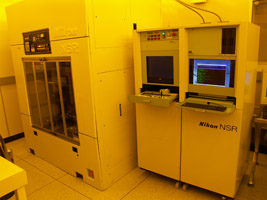
The Nikon NSR-1505G4 is a wafer stepper with 5x reduction for 5-inch reticles and 4-inch wafers, using g-line UV and providing better than 750 nm resolution and better than 150 nm alignment.

The Nanoscribe Photonic Professional GT+ is a 3D nanoprinter for two-photon polymerization using an infrared 780 nm femtosecond laser.
Brooks 017-0146-01 is a prealigner manufactured by Brooks.