GCA
6300 DSW
The GCA 6300 DSW is a step-and-repeat photolithography wafer stepper. The GCA 6300 DSW uses a 5:1 reduction lens and can be configured with either a g-line (436 nm) or i-line (365 nm) exposure wavelength.[1][2]
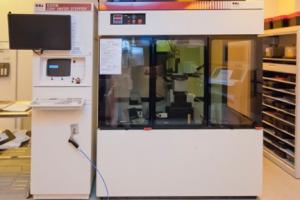
What it is
General reference — not yet source-verifiedA wafer stepper is a projection lithography tool used to transfer reticle patterns into photoresist on a substrate. A wafer stepper sits in the lithography module of a process flow and is used when patterned layers require optical reduction imaging, field by field exposure, and overlay to earlier layers.
How it works
The GCA 6300 DSW projection printer uses a g-line lens column with 0.30 numerical aperture to provide 5:1 reduction. The GCA 6300 DSW is a step and repeat exposure system with laser-controlled stage motion. The GCA 6300 DSW has programmable die number and die placement. The GCA 6300 DSW can be converted to function as a GCA 3696 photorepeater system for exposing photoresist coated glass plates up to 7 inches.[1]
Where it fits in the process flow
General reference — not yet source-verifiedPhotolithography with a wafer stepper is performed after a substrate has been prepared with a film stack and coated with photoresist. Stepper exposure is followed by resist development and then by pattern transfer or material processing such as etch, implantation, plating, or liftoff, depending on the layer being built.
Applications
The GCA 6300 DSW is used for lithography on wafers and smaller pieces. The GCA 6300 DSW supports programmable placement of dies across the substrate. The GCA 6300 DSW can also be configured in photorepeater mode for exposing photoresist coated glass plates up to 7 inches.[1][4]
- photolithography
- step and repeat exposure
- high-resolution lithography
- critical alignment
What do the numbers mean?
Wafer handling12
Optics & imaging22
Performance5
Dimensions & facilities1
Configuration & options14
Vintage & configurations
Documented models & variants
Where are the manuals?
Publicly hosted documents referencing this tool, linked at their original location. Hosted by the linked institutions — availability may change.
- GCA 5X Operation ManualManualcornell.edu
- GCA 5X Resist InformationDocumentcornell.edu
Generated from public-source data on file. Enter your email to access — nothing is published; details are routed privately.
Not publicly documented
Field notes
No research found yet — worked with this tool? Share what you know.
Frequently asked questions
Not publicly documented
The following facts about the 6300 DSW are absent from this record as of this revision. First-hand knowledge or a citation closes a gap; every submission is reviewed before publication.
No publicly documented production dates or lifecycle milestones (introduction, end of production, EOL) for the 6300 DSW are on record.
Answerable by: OEM historical records or a trade-press announcement
The control-system platform and OS era of the 6300 DSW are not on record.
Answerable by: an engineer who operated it or OEM installation records
No publicly documented failure modes or field errata for the 6300 DSW are on record.
Answerable by: a field service engineer, process engineer, or maintenance technician
No publicly documented compatible parts, consumables, or accessories for the 6300 DSW are on record.
Answerable by: an OEM parts catalog or a service engineer
No research found yet — worked with this tool? Share what you know.
Sources & citations
Sources (4)Every fact above is drawn from these public sources
- [1]cnfusers.cornell.edu — cnfusers.cornell.educnfusers.cornell.edu
- [2]wiki.nanofab.ucsb.edu — wiki.nanofab.ucsb.eduwiki.nanofab.ucsb.edu
- [3]waferpedia.comwaferpedia.com
- [4]https://www.cnfusers.cornell.edu/sites/default/files/Equipment-Resources/GCA%20Stepper%20Manual_GB.pdf — cnfusers.cornell.educnfusers.cornell.edu
Last updated Oct 21, 2026.
Compare with similar tools
View all →
The MA / BA Gen4 Pro Series is a semi-automated mask aligner and bond aligner system supporting wafers up to 150 mm / 200 mm, with capabilities for exposure, UV bonding, fusion bonding, micro- and nanoimprinting, and selective plasma activation.
The MA100 / 150e Gen2 is an automated mask aligner for proximity exposure, supporting wafer sizes up to 150 mm.

The Karl Suss MA6 is a high-resolution semi-automated photolithography mask aligner for research, development, and small-volume production.
